
Home contest Media Kit Booksellers FAQs Contact Site

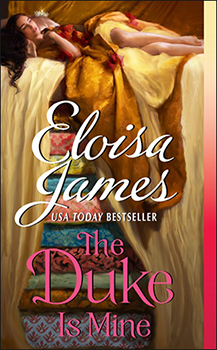
The Duke is Mine


Tarquin, the powerful Duke of Sconce, knows perfectly well that the decorous and fashionably slender Georgiana Lytton will make him a proper duchess. So why can’t he stop thinking about her twin sister, the curvy, headstrong, and altogether unconventional Olivia? Not only is Olivia betrothed to another man, but their improper, albeit intoxicating, flirtation makes her unsuitability all the more clear. 


Determined to make a perfect match, he methodically cuts Olivia from his thoughts, allowing logic and duty to triumph over passion…Until, in his darkest hour, Tarquin begins to question whether perfection has anything to do with love


To win Olivia's hand he would have to give up all the beliefs he holds most dear, and surrender heart, body and soul…


Unless it’s already too late.

Read Chapter OneRead Chapter TwoRead Chapter Three

The Duke is Mine is Book 3 of Eloisa's Fairy Tales. Read more from Eloisa's Fairy Tales:


Avon
December 27, 2011
isbn-10: 0062021281
isbn-13: 978-0062021281

The Duke is Mine

The Duke is MineI'm the kind of writer who can't seem to think in terms of one book: I invariably design a world that takes up three or four books. This leads to a virtual web of connections between my books. So what I offer below is something of a family tree, a way of chasing the characters whom you particularly like through several books, or of figuring out why a character's name sounds so very familiar to you.

Warning! In describing relations between characters, I may wreck a book for you by making it clear who someone marries, or the outcome of a book. Please do not read about The Inside Take if you're wary of knowing who is paired with whom!

» The Duke is Mineis structured around the fairy tale of The Princess and the Pea. I started off writing the story happily enough (I love the scene when Olivia arrives in the middle of the night), but I quickly ran into trouble with that pea. How on earth was I going to maneuver Olivia in a room with a load of mattresses? Why would anyone stack mattresses almost to the ceiling, and how was she (a reasonable girl) supposed to feel a pea at the bottom of them? It was a glorious day when I figured out the answers to those questions...

» Another problem I faced in shaping this story was creating a hero who didn’t care if his mother chose his wife for him. Quin was in danger of turning into a mama’s boy, or someone so uninterested in women that he probably shouldn’t marry at all. Then one day I figured out the key to his character while reading an article in The New York Times that quoted Bob Lemon, the former Cleveland Indians pitcher and Yankees manager. "I've had everything in baseball a man could ask for. I've been so fortunate,” Lemon apparently said. “Outside of my boy getting killed. That really puts it in perspective. So you don't win the pennant. You don't win the World Series. Who gives a damn? Twenty years from now, who'll give a damn?" Quin’s grief was inspired by the suffering behind Lemon’s questions…his words gave me the key to Quin’s character.

» Olivia’s mother is obsessed by a manual that actually existed, although I took huge liberties with the text. The Mirrour of Complementswas printed in 1650. I think its subtitle says it all: “or, A Manuall of choice, requisite, and compendious curiosities wherein gentlemen, ladies, gentlewomen, and all others may practise complemental and amorous expressions, in speaking or writing letters, upon any subject or occasion : exactly performed with addition of witty songs, sonnets, poems, epigrams, essays, characters, &c.

» Here’s a fun little tidbit: the first time I wrote this novel, or at least the first 175 pages, Olivia wasn’t the heroine. Her sister Georgiana (aka the Perfect Duchess) was. That made sense, right? Georgiana could pass any number of tests... but she didn’t make the book sing. And meanwhile Olivia was stealing the show. Someday I might write Georgiana’s story... right now, I’m happy thinking of her off at university learning complicated algebra and planning to trounce Quin at all his mathematical equations someday.
Lucy

» Lucy in The Duke is Mine is my own dog. We rescued her from a shelter called Secondhand Hounds run by Connie Brockway’s fabulous daughter. In the beginning there was some rumbling in our household about the fact that Lucy was not cute and furry... but now everyone loves her to death. It was great fun to put her in the novel; if you want to see her in video, here she is!

» Talking of beloved beings in our household… I hope you enjoyed Sir Justin Fiebvre as much as did my daughter Anna (aged 11-12) while I was writing this book. Every day she would ask me to write more about him, since my character was the closest she would ever come to talking to her great passion, Justin Bieber himself. It was a hard lesson when she realized that Sir Justin was only a secondary character. Still, I hope I managed to capture something of the singer’s talent and effortless charm (I ought to be able to: I think I’ve seen his movie four times!).

Back to Top

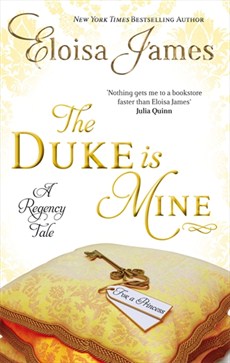
The Duke is Mine (U.K. Cover)
IN U.K.


Duke hit The New York Times, USA Today, and Publishers Weekly bestseller lists: thank you!


"What I loved most about Lady Olivia is that she's so unique. She's plump and average, enjoys potty humor, and says the most inappropriate things. I love a heroine who isn't perfect! Her future mother-in-law wouldn't agree to be certain... but that's what makes it so great…the story was amusing and the characters were delightful.”

-The San Francisco Book Review, January 2012  (posted May 7, 2012)

Top pick, and "extended" blog review!
"James charms with an updated version of “The Princess and the Pea.” Her empowered and unconventional heroines, her intelligent heroes and her witty dialogue merge perfectly with modern themes, enthralling readers."

- Romantic Times BOOKReviews, January 2012  (posted December 6, 2011)

Starred review!
"With rapier wit, bawdy wordplay, and a stinging sense of fun, James targets social rigidity, explores the meaning of perfection (and heroism), and catches readers off guard with any number of unexpected twists. A brilliant new spin on another classic tale; readers will never again look at peas, mattresses, or even heroes in the same way."

- Library Journal, January 2012  (posted December 6, 2011)

"James’s Regency-era rendition of “The Princess and the Pea” hits the trifecta of sizzing romance, engaging characters, and an enthralling, quick-moving story."

- Publisher's Weekly, December 2011  (posted December 6, 2011)

Back to Top


The Duke Is Mine

The Duke Is Mine

The Duke Is Mine


The Duke Is Mine

The Duke Is Mine The Duke Is Mine
The Duke Is Mine
The Duke Is Mine
The Duke Is Mine
The Duke Is Mine
The Duke Is Mine


Chapter One

In Which We Are Introduced to a Future Duchess

41 Clarges Street, Mayfair
London
The residence of Mr. Lytton, Esq.

Most betrothals spring from one of two fierce emotions: love or greed. But Olivia Lytton’s was fueled neither by an exchange of assets between like-minded aristocrats, nor by a potent mixture of desire, propinquity, and Cupid’s arrows.

In fact, the bride-to-be was liable, in moments of despair, to attribute her engagement to a curse. “Perhaps our parents forgot to ask a powerful fairy to my christening,” she told her sister Georgiana on their way home from a ball given by the Earl of Summers, at which Olivia had spent generous swaths of time with her betrothed. “The curse, it hardly needs to be said, was Rupert’s hand in marriage. I would rather sleep for a hundred years.”

“Sleeping has its attractions,” her sister agreed, descending from their parents’ carriage before the house. Typically, Georgiana did not pair the positive comment with its opposite: Sleep had attractions… but Rupert had few.

Olivia actually had to swallow hard, and sit in the dark carriage by herself a moment, before she was able to pull herself together and follow her sister. She had always known that she would be Duchess of Canterwick someday, so it made no sense to feel so keenly miserable. But there it was. An evening spent with her future husband made her feel half cracked.

It didn’t help that most of London, her mother included, considered her the luckiest of young women. Her mother would be horrified—though unsurprised—by her lame jest linking the dukedom with a curse. To Olivia’s parents, it was manifestly clear that their daughter’s ascension of the social ranks was a piece of singular good fortune. In short, a blessing.

Although, putting aside notions of good or evil, Olivia’s betrothal was really the result of a boyhood promise.

“Thank God,” Mr. Lytton had said, oh, five thousand times since Olivia was born, “If I hadn’t gone to Eton…”

It was a story that Olivia and her twin sister Georgiana had loved when they were little. They would perch on their papa’s knees and listen to the thrilling tale of how he—plain, unremarkable (albeit connected to an earl on one side, as well as a bishop and a marquess on the other) Mr. Lytton—had gone to Eton and become best friends with the Duke of Canterwick, who had inherited his grand title at the tender age of five. The next part of the story kept changing, but whether it was because their father had fought off a bully in the schoolyard, or had written the duke’s essays for him, or something altogether more consequential…it didn’t matter. At age fourteen, the boys had sworn a blood oath that Mr. Lytton’s eldest daughter would become a duchess by marrying the Duke of Canterwick’s eldest son.

Mr. Lytton showed giddy enthusiasm in doing his part to ensure this eventuality, producing not one, but two daughters, within a year of marriage. The Duke of Canterwick, for his part, produced only one son, and that after a few years of marriage, but obviously one son was sufficient for the task at hand. Most importantly, His Grace kept his word, and regularly reassured Mr. Lytton about the destined betrothal.

Consequently, the proud parents of the duchess-to-be did everything in their power to prepare their firstborn daughter (the elder by a good seven minutes) for the title that was to be bestowed upon her, sparing no expense in shaping the future Duchess of Canterwick. Olivia was tutored from the moment she left the cradle. By ten years of age, she was expert in the finer points of etiquette, the management of country estates (including double-entry accounting), playing the harpsichord and the spinet, greeting people in various languages including Latin (useful for visiting bishops, if no one else), and even in French cooking, though her knowledge of the last was intellectual rather than practical. Duchesses never actually touched food, except to eat it.

She also had a thorough knowledge of her mother’s favorite tome, The Mirror of Compliments: A Complete Academy for the Attaining unto the Art of Being a Lady, which was written by no less a personage than Her Grace, the Duchess of Sconce.

In fact, Olivia’s mother had read The Mirror of Compliments so many times that it had taken over her conversation, rather like ivy smothering a tree. “Gentility,” she had said that morning over marmalade and toast, “is bestowed on us by our ancestors, but soon blanched, when not revived by virtue.” Olivia had nodded. She herself was a firm believer in the benefits of blanching gentility, but long experience had taught her that expressing such an opinion would merely give her mother a headache.

A duchess,” Mrs. Lytton had announced on the way to Summers ball, “loathes nothing so much as entering parley with an immodest suitor.” Olivia knew better than to inquire about how one “parleyed” with an immodest suitor. The ton understood that she was betrothed to the Duke of Canterwick’s heir, and therefore suitors, immodest or otherwise, rarely bothered to approach.

Generally speaking, she tabled that sort of advice for the future, when she hoped to indulge in any number of immodest parleys.

“Did you see Lord Webbe dancing with Mrs. Shottery?” Olivia asked her sister as they walked into her bedchamber. “It’s quite affecting to watch them stare into each other’s eyes. I must say, the ton seems to take their wedding vows about as seriously as do the French, and everyone says that inclusion of marital fidelity in French wedding vows turned them a splendid work of fiction.”

Olivia!” Georgiana groaned. “You mustn’t! And you wouldn’t—would you?”

“Are you asking whether I will ever be unfaithful to my fiancé once he’s my husband—if that day ever arrives?”

Georgiana nodded.

“I suppose not,” Olivia said, though secretly she sometimes wondered if she might just snap one day and break every social rule by running off to Rome with a footman. “The only part of the evening I really enjoyed was when Lord Bladder told me a limerick about an adulterous abbot.”

“Don’t you dare repeat it!” her sister ordered. Georgiana had never shown the faintest wish to rebel against the rules of propriety. She loved and lived by them.

“There once was an adulterous abbot,” Olivia teased, “as randy—“

Georgiana slapped her hands over her ears. “I can’t believe he told you such a thing! Father would be furious, if he knew.”

“Lord Bladder was in his cups,” Olivia said. “Besides, he’s ninety-six and he doesn’t care about decorum any longer. Just a laugh, now and then.”

“It doesn’t even make sense. An adulterous abbot? How can an abbot be adulterous? They don’t even marry.”

“Just let me know if you want to hear the whole verse,” Olivia said. “It ends with talk of nuns, so I believe the word was being used loosely.”

That limerick—and Olivia’s appreciation of it—pointed directly to the problem with Miss Lytton’s duchess-ification—or, as the girls labeled it, “duchification.” There was something very unducal about Olivia, no matter how proper her bearing, her voice, and her manners might be. She certainly could play the duchess, but the real Olivia was, dismayingly, never far from the surface.

“You are missing that indefinable air of consequence that your sister conveys without effort,” her father often opined, with an air of despondent resignation. “In short, Daughter, your sense of humor tends toward vulgar.”

Your demeanor should ever augment your honor,” her mother would chime in, quoting the Duchess of Sconce.

And Olivia would shrug.

“If only,” Mrs. Lytton had said despairingly to her husband time and again, “if only Georgiana had been born first.” For Olivia was not the only participant in the Lytton training program. Olivia and Georgiana had marched in lockstep through lessons on comportment and deportment, because their parents, aware of the misfortunes that might threaten their eldest daughter—a fever, a runaway carriage, a fall from a tower—had prudently duchified their second-born as well.

Sadly, it was manifest to everyone that Georgiana had achieved the quality of a duchess while Olivia… Olivia was Olivia. She certainly could behave with exquisite grace—but among her intimates, she was sarcastic, far too witty to be ladylike, and not in the least gracious. “She looks at me in such a way if I merely mention The Mirror of Compliments,” Mrs. Lytton would complain. “I’m only trying to help, I’m sure.”

“That girl will be a duchess someday,” Mr. Lytton would say heavily. “She’ll be grateful to us then.”

“But if only…” Mrs. Lytton would say, wistfully. “Dearest Georgiana is just…well, she would be a perfect duchess, wouldn’t she?”

In fact, Olivia’s sister had mastered early the delicate art of combining a pleasing air of consequence with an irreproachably modest demeanor. Over the years Georgiana had built up a formidable array of duchess-like traits: ways of walking, talking, and carrying herself. Even more importantly, she had a duchess’s touch: she knew instinctively how to behave in any situation.

Dignity, virtue, affability, and bearing,” Mrs. Lytton recited over and over, turning it into a nursery rhyme.

Georgiana would glance at the glass, checking her dignified bearing and affable expression.

Olivia would sing back to her mother: “Debility, vanity, absurdity, and…brainlessness!

By eighteen years of age, Georgiana looked, sounded, and even smelled(thanks to French perfume, smuggled from enemy territory at great expense) like a duchess. Mostly Olivia didn’t bother.

The Lyttons were happy, in a measured sort of way. By any sensible standard they had produced a real duchess, even if that particular daughter was not betrothed to a duke’s heir. As their girls were growing up, they told themselves that Georgiana would make a lovely wife to any man of rank. Alas, in time they stopped saying anything about their second daughter’s hypothetical husband.

The sad truth is that a duchified girl is not what most young men desire. While Georgiana’s virtues were celebrated far and wide throughout the ton—especially amongst the dowager set—her hand was rarely sought for a dance, let alone for marriage.

Mr. and Mrs. Lytton interpreted the problem differently.  To their mind, their beloved second daughter was likely to dwindle into the shadow of a duchess, without becoming even a wife, merely because she had no dowry.

The Lyttons had spent all their disposable income on tutors, not to mention saving for Olivia’s dowry. That left their younger daughter without more than a pittance to launch her on the marriage market.

“We have sacrificed everything for that girl,” Mrs. Lytton often said. “I can’t understand why Olivia is not more grateful. She’s the luckiest girl in England.”

Olivia did not view herself as lucky at all.

“The only reason I can countenance marrying Rupert,” she said to Georgiana, “is that I will be able to dower you.” She stripped off her gloves, biting the tips to pull them from her fingers. “To be honest, the mere thought of the wedding makes me feel slightly mad. I could bear the rank—though it isn’t my cup of tea, to say the least—if he weren’t such a little, beardy-weirdy bottle-headed chub.”

“You’re using slang,” Georgiana said. “And—“

“Absolutely not,” Olivia said, throwing her gloves onto her bed. “I made it up myself, and you know as well as I do that the Mirror for Bumpkins says that slang is—and I quote—grossness of speech used by the lowest degenerates in our nation. Much though I would like to attain the qualifications of a degenerate, I have no hope of achieving that particular title in this life.”

“You shouldn’t,” Georgiana said, arranging herself on the settee before Olivia’s fireplace. Olivia had been given the grandest bedchamber in the house, larger than either their mother’s or father’s chambers, so the twins hid from their parents in Olivia’s room.

But the reprimand didn’t have her usual fire. Olivia frowned at her sister. “Was it a particularly rotten night, Georgie? I kept getting swept away by my dim-witted fiancé, and after supper I lost track of you.”

“I would have been easy to find,” Georgiana replied. “I sat among the dowagers most of the night.”

“Oh, sweetheart,” Olivia said, sitting down next to her sister and giving her a fierce hug. “Just wait until I’m a duchess. I’ll dower you so magnificently that every gentleman in the country will be on bended knee at the very thought of you. ‘Golden Georgiana,’ they’ll call you.”

Georgiana didn’t even smile, so Olivia forged ahead. “I like sitting with the dowagers. They have all the stories one would really like to hear, like that one about Lord Mettersnatch paying seven guineas to be flogged.”

Her sister’s brows drew together.

“I know, I know!” Olivia exclaimed, before Georgiana could speak. “Vulgar, vulgar, vulgar. All the same, I loved the part about the nursemaid costume. Truly, you should be glad you weren’t me. Canterwick stalked up and down the ballroom all night, dragging Rupert and me behind him. Everyone groveled, tittered behind my back, and went off to inform the rest of the room how uncommonly unlucky the FF is to be marrying me.”

Between themselves, Olivia and Georgiana generally referred to Rupert Forrest G. Blakemore—Marquess of Montsurrey, future Duke of Canterwick—as “the FF,” which stood for foolish fiancé. On occasion he was also “the HH” (half-wit husband), “the BB” (brainless betrothed) and—because the girls were fluent in both Italian and French—“the MM” (mindless marito or mindless mari, depending on the language of the moment).

“The only thing lacking to make this evening absolutely and irredeemably hellish,” Olivia continued, “was a wardrobe malfunction. If someone had stepped on my hem and ripped it, baring my arse to the world, I might have been more humiliated. I certainly would have been less bored.”

“In my opinion, our gowns qualify as wardrobe malfunctions without the addition of rips,” Georgiana said, tipping her head back and staring at the ceiling.

She looked miserable. Olivia felt a pang of alarm. Georgiana so rarely allowed a real emotion to disrupt her façade of serenity that a drooping mouth was akin to hysteria in another woman. “We should look on the bright side,” she said, striving for a rousing tone. “The FF danced with both of us. Thank goodness he’s finally old enough to attend a ball.”

“He counted the steps aloud,” Georgiana stated. “And he said my dress made me look like a puffy cloud.”

 “Surely it could not have surprised you to discover that Rupert lacks a gift for elegant conversation. If anyone looked like a puffy cloud, it was I; you looked like a vestal virgin. Far more dignified than a cloud.”

Georgia just kept silently staring at the ceiling, so Olivia rattled on. “a virginal lady would surely have to be unwilling to qualify as a sacrifice. From what I saw tonight, London is full of virgins desperate to sacrifice themselves, if you think of matrimony as a kind of death, which I do.”

“I don’t,” her sister said, turning her head. Her eyes were full of tears.

“Oh, Georgie!” Olivia gathered her into another hug. “Please don’t cry. I’ll be a duchess in no time, and then I’ll dower you and order such beautiful clothing that you’ll be the wonder of London.”

“This is my fourth season, Olivia. You can’t possibly understand how dreadful it feels, given that you’ve never really been on the market. No gentleman paid me attention tonight, any more than they have in the last three years.”

“It was the dress and the dowry. We all looked like ghosts, but not transparent. You, of course, were a willowy ghost and I was a particularly solid one.”

Olivia and Georgiana had worn matching gowns of frail white silk, caught up under their bosoms with long ribbons trimmed with seed pearls and tasseled at the ends. The same streamers appeared on the sides and the backs of the gowns, rippling in the faintest breeze. On the page, in Madame Wellbrook’s pattern book, the design had looked exquisite.

There was a lesson there…a dismal one.

Just because fluttering ribbons look good on a stick-thin lady portrayed in a pattern book does not mean that they will be when festooned around one’s hips.

“I caught sight of you dancing with that bald man,” Olivia continued. “You looked like a bouncy maypole with all those ribbons trembling around you. Your ringlets were bouncing as well.”

“Lord Galligasken is a vigorous dancer.” Georgiana managed a wobbly smile. “I don’t think I looked like a maypole. More like a little suckling pig, one of those white ones you see in fairs that can stand up on its back legs.”

“Only if it were a very thin pig wearing a silk apron with long ties,” Olivia replied, after giving the idea some consideration. “And a wig with long ringlets. Though no pig would put up with the two hours it took to shape these blasted curls. Besides, if either of us looked like a piglet, Georgie, it was obviously me. That miserable gown flattered your figure, not that you needed it.”

“It doesn’t matter,” Georgiana said flatly. She brushed away a tear. “It’s the duchification, Olivia. No man wants to marry a prude who acts as if she’s a ninety-five-year-old dowager. And”—She gave a little sob—“I simply can’t seem to behave any differently. I don’t believe that anyone titters behind your back, unless from jealousy. But I’m like nursery gruel. I—I can see their eyes glaze over when they have to dance with me.”

Privately, Olivia agreed that the duchification program had much to answer for. But she wrapped her arm tighter around her sister and said, “Georgiana, you have a wonderful figure, you’re sweet as honey, and the fact that you know how to set a table for one hundred has nothing to do with it. Marriage is a contract, and contracts are about money. A woman has to have a dowry or no man will even consider marrying her.”

Georgiana sniffed, which served to demonstrate how upset she was, as she normally would never countenance such an unrefined gesture.

“Your waist makes me positively sick with envy,” Olivia added. “I look like a butter churn, whereas you’re so slim that I could balance you on the head of a pin, like an angel.”

Most young ladies on the marriage market—Georgiana included—were indeed ethereally slim. They floated from room to room, diaphanous silk sweeping around their slender bodies.

Olivia was not one of them. It was the sad truth, the canker at the heart of the ducal flower, another source of stress for Mrs. Lytton. As she saw it, Olivia’s over-indulgence in vulgar wit and buttered toast stemmed from the same character defects. Olivia did not disagree.

“May I borrow a handkerchief?” Georgiana asked, sniffing again.

“I’ll find one,” Olivia said, jumping up and beginning to rummage through her wardrobe. “Here, use this.” She tossed a piece of cloth to her sister.

It landed on Georgiana’s shoulder, and she plucked it off with a frown. “A chemise? You want me to blow my nose on a chemise?”

“Why not? There don’t seem to be any handkerchiefs here. I’m not sure where Norah keeps them.”

“Because it takes at least three times the work to launder and iron a chemise as it takes to do the same for a handkerchief,” her sister said, a bit of steel in her voice.

“It’s the chemise or nothing,” Olivia said, coming back to the sofa. “But darling…”

“What?” Georgiana asked, her voice muffled by the chemise.

“You might want to try to be less virtuous, if you see what I mean.”

“But I’m right.”

Olivia was silent.

“You’re saying that I’m a sanctimonious prig,” Georgiana said, another sob escaping, with a hiccup in tow.

“No! I think you’re the most intelligent woman I know, and your ethical sense is admirable. Truly. It never would have occurred to me to consider the labor behind an ironed handkerchief versus a chemise.”

Georgiana hiccupped again. “A—a duchess needs to know that sort of thing in order to run a large household. Not that I’ll ever have a husband, let alone a household.”

“This reminds me!” Olivia cried. “I heard tonight that the Duke of Sconce is going to take a wife. I suppose he needs an heir. Just imagine, Georgie. You could be daughter-in-law to the most stiff-rumped starch bucket of them all. Do you suppose the duchess reads her Maggoty Mirror aloud at the dining table? She would adore you. In fact, you’re probably the only woman in the kingdom whom she would love.”

“Dowagers always love me,” Georgiana said with another sniff. “That doesn’t mean the duke will give me a second glance. Besides, I thought that Sconce was married.”

“If the duchess approved of bigamy she would have put it in the Mirror; therefore, its absence suggests that he is need of a second wife. By the way, Mother has decided that I should try a lettuce diet that someone told her about.”

“Lettuce?”

“One eats only lettuce between the hours of eight and eight.”

“That’s absurd. If you want to reduce, you should stop buying meat pies when Mama thinks you’re buying ribbons. Though to be honest, Olivia, I think you should eat whatever you want. I want quite desperately to marry, and even so, the idea of marrying Rupert makes me want to eat a meat pie.”

“Four pies,” Olivia corrected. “At least.”

“What’s more, it doesn’t matter how slim you could become by eating lettuce,” Georgiana continued. “The FF has no choice but to marry you. If you grew rabbit ears, he would still have to marry you. Whereas no one can countenance the idea of marrying me, no matter what my waist looks like. I need money to—to bribe them.” Her voice wavered again.

“They’re all port-brained buffoons,” Olivia said, with another squeeze. “They haven’t noticed you, but they will, once Rupert dowers you.”

“He’ll forget to sign the papers,” Georgiana said damply. “He rattled on and on about fighting the French, but when I asked him where the battle was located at the moment, he couldn’t remember. The way he crowed about achieving honor, I expect he’s across the Channel by now.”

“Not quite yet,” Olivia stated.

There was a moment of silence, and then Georgiana sat bolt upright. “Don’t tell me that the FF is finally pledging himself? He’s going to marry you before he leaves for the war?”

“Close.” Olivia would have loved to explain away her immediate and visceral reaction to the word “marry” by a bad shrimp. But a feeling this overwhelming would imply she had eaten an entire ocean of bad shrimp. Instead, there was just one bad fiancé, who would likely resent being compared to a bit of aged seafood.

“He obtained a special license!”

“No, it’s to be a betrothal only, but I understand this is legally binding. Rupert is coming over with his father to sign the papers tomorrow evening.”

“For goodness’ sake,” Georgiana gasped. “You really are going to become a duchess. The FF is about to become the BB!”

“Foolish fiancés are often killed on the battlefield,” Olivia pointed out. “I think the term is ‘cannon fodder.’”

Her sister gave a sudden laugh. “You could at least try to sound sad at the prospect.”

“I would be sad,” Olivia protested. “I think.”

“You’d have reason. Not only would you lose the prospect of being ‘Your Grace’d for the rest of your life, but our parents would hold hands as they jumped off Battersea Bridge to their watery deaths.”

“I can’t even imagine what Mama and Papa would do if the goose that promised golden eggs was turned into pâté de foie gras by the French,” Olivia said, a bit sadly. It seemed that as each year went by, her parents were less and less interested in their eldest daughter as a person, as opposed to a duchess. Though really, had they ever expressed interest in anything but her duchess-designed accomplishments?

“What happens if the FF dies before marrying you?” Georgiana asked. “Legal or not, a betrothal is not a wedding.”

“I gather these papers make the whole situation a good deal more solid,” Olivia said. “I’m certain most of the ton believes that he’ll cry off before we get to the altar, given my general lack of beauty, not to mention the fact that I don’t eat enough lettuce.”

The Duke is Mine Chapter Two Chapter Three

“Don’t be ridiculous. You are beautiful,” Georgiana said. “You have the prettiest eyes I’ve ever seen. I can’t think why I got plain brown eyes and you have those green ones.” She peered at her. “Pale green. The color of celery, really.”

“If my hips were like celery, then we’d have something to celebrate.”

“You’re luscious,” her sister insisted. “Like a sweet, juicy peach.”

“I don’t mind being a peach,” Olivia said. “Too bad celery is in fashion.”

End of Chapter One. Like it? Order it!

Back to Top


chapter two

In Which We Are Introduced to a Duke

Tatterstall Manor
Seat of the Duke of Sconce
Kent

At the precise moment that Olivia and Georgiana were engaged in an agricultural wrangle over the relative merits of peaches and celery, the hero in this particular fairy story was certainly not behaving like the princes in most such tales. He wasn’t on bended knee, or on a white horse, and he was nowhere near a beanstalk. Instead, he was sitting in his library, working on a knotty mathematical problem: specifically, Lagrange's four-square theorem. To clarify my point, if this particular duke ever encountered a beanstalk of unusual size, it would doubtless have spurred a leap in early botanical knowledge regarding unusual plant growth—but certainly not a leap up the said stalk.

It should be obvious from the above that the Duke of Sconce was the sort of man repulsed by the very idea of fairy tales. He neither read nor thought about them (let alone believed in them); the notion of playing a role in one would have been preposterous, and he would have rejected outright the notion that he resembled in any fashion the golden-haired, velvet-clad princes generally found in such tales.

Tarquin Brook-Chatfield, Duke of Sconce—known as Quinn to his intimates, who numbered exactly two—was more like the villain in those stories than the hero, and he knew it.

He couldn’t have said at what age he discovered how profoundly he did notresemble a fairy tale prince. He might have been five, or seven, or even ten—but at some point he realized that coal-black hair with a shock of white over the forehead was neither customary nor celebrated. Perhaps it was the first time that his cousin Peregrine called him a decrepit old man (a remark that had led to a regrettable scuffle).

Yet it wasn’t only his hair that set him apart from other lads. Even at ten years of age, he had stern eyes, fiercely cut cheekbones, and a nose that screamed aristocrat. By thirty-two, there were no more laughter lines around his eyes than had been visible twenty years earlier, and for good reason.

He almost never laughed.

But Quinn did have one major point of resemblance with the hero of The Princess and the Pea, whether he would have acknowledged it or no: his mother was in charge of choosing his wife, and he didn’t give a hang what criteria she applied to the task. If she thought a pea under a mattress—or under five mattresses—was the way to ascertain the suitability of his future duchess, Quinn would have agreed, just as long as he didn’t have to bother about the question himself.

In this crucial fashion, he was as regal—as real—as the nameless prince in the fairy tale, as dukified as Georgiana was duchified. He rarely saw a doorway without advancing through it as if he owned it. Since he owned a good many doorways, he would have pointed out that this was a reasonable presumption. He looked down his nose because it was there to look down and he was taller than most; arrogance was his birthright. He couldn’t conceive of any other way of behaving.

To be fair, Quinn did acknowledge some personal failings. For example, he seldom knew what the people around him were feeling. He had a formidable intelligence and rarely found other people’s thought patterns very surprising. But their emotions? He greatly disliked the way people seemed to conceal their emotions, only to release them in a gassy burst of noise and a tearful exposition.

This antipathy to displays of feeling had led him to surround himself with people like his mother and himself: to wit, those who responded to a problem by formulating a plan, often involving experimentation designed to prove a given hypothesis. What’s more, his selected few did not cry if their hypotheses proved incorrect.

He rather thought that people shouldn’t have so many emotions, given that feelings were rarely logical, and therefore were of no use whatsoever. He had embarrassed himself once by falling into a slough of emotion—and it hadn’t ended well.

In fact, it had ended miserably.

The very thought sent a pulse of black pain through the region that he generally supposed to house his heart, but he ignored it, as was his habit. If he paid attention to how many times a month, a week—a day—he felt that little stab… There was no point in thinking about it.

If there was one thing he had learned from his mother, it was that regrettable emotions are best forgotten. And if one cannot forget (he couldn’t), then that personal failing should be concealed.

As if thinking of his mother had brought her to his side, the door to his library opened and his butler, Cleese, intoned, “Her Grace.”

“My plans are in order, Tarquin,” his mother declared, entering on the heels of Cleese’s announcement. She was followed closely by her personal assistant, Steig, and by her personal maid, Smithers. Her grace, the dowager duchess, preferred to have a little flock of retainers in tow wherever she went, rather as if she were a bishop trailed by anxious acolytes. She was not a tall woman, but she projected such a formidable presence that she achieved the impression of height, albeit with some help from a towering wig. In fact, her wig bore a distinct resemblance to a bishop’s miter. They both advertised the wearer’s confidence in his or her rightful place in the universe: to wit, on top.

Quinn was already on his feet; now he moved from behind his desk to kiss the hand his mother held out. “Indeed?” he asked politely, which gave him time to push the fascinating scramble of numbers he’d been working on from his head, while trying to remember what she was talking about.

Fortunately, the duchess did not view responsiveness as an obligatory aspect of conversation. Given a choice, she would prefer to soliloquize, but she had learned to give addresses that could almost be classified as interactive.

“I have chosen two young ladies,” she pronounced now. “Both from excellent families, it hardly needs saying. One is from the aristocracy and one is from the gentry. I think we both agree that to consider only the aristocracy is to show anxiety about the matter, and the Sconces need have no such emotion.”

She paused, and Tarquin nodded obediently. He had learned as a child that anxiety—like love—was an emotion disdained among the aristocracy.

“Both mothers are aware of my treatise,” his mother continued, “and I have reasonable faith that their daughters will surmount the series of tests I shall put to them, drawn, of course, from The Mirror of Compliments. I have put a great deal of preparation into their visit, Tarquin, and it will be a success.”

By now Quinn knew exactly what his mother was talking about: his next wife. He approved of both Her Grace’s planning and her expectation of success. His mother organized every aspect of her life—and often, his as well. The one time he had engaged in spontaneity—a word and an impulse he now regarded with the deepest suspicion—the result had been disastrous.

Thus the need for a next wife. A second wife.

“You shall be married by autumn,” his mother stated.

“I have the utmost confidence that this endeavor, like all those you undertake, will be a success,” he replied, which was no more than the truth.

His mother didn’t flicker an eyelash. Neither of them had time for frivolity or frivolous compliments. As his mother had written in her book, The Mirror of Compliments—which rather surprisingly had become a best-selling volume—A true lady prefers gentle reproof to extravagant compliment.

It hardly need be said that Her Grace would have been extremely surprised if offered a reproof, gentle or otherwise.

“Once I have found you a wife who is worthy of her position, I shall be happy,” she said now, then added, “What are you working on?”

Quinn looked back at his desk. "I am writing a paper on Lagrange's solution to Bachet's conjecture regarding the sum of four squares.”

"Didn't you tell me that Legendre had already improved on Lagrange's theorem?"

"His proof was incomplete.”

“Ah.” There was a momentary pause, and then the dowager said, “I shall issue an immediate invitation to the chosen young ladies to join us here. After due observation, I shall make a choice. A reasoned choice. There will be no succumbing to light fancy, Tarquin. I think we both agree that your first marriage made patently clear the inadvisability of such behavior.”

Quinn inclined his head—but he didn’t entirely agree. His marriage had been inadvisable, surely. Terrible, in some lights (the fact that Evangeline had taken a lover within a few months spoke for itself). Still…

“Not in every respect,” he said now, unable to stop himself.

“You are contradicting yourself,” his mother observed.

“My marriage was not a mistake in every respect.” He and his mother lived together quite comfortably, but he was well aware that the household’s serenity was dependent on the fact that he generally took the path of least resistance. When necessary, however, he could be as firm as the dowager.

“Well,” his mother replied, eyeing him. “We must each be the judge of that.”

I am the judge of my marriage,” Quinn stated.

“The question is irrelevant,” she replied, waving her fan as if to brush away an insect. “I shall do my best to steer you in such a way that you shall not fall into the same quagmire. I feel quite exhausted at the mere memory of the tempests, the pique, the constant weeping. One would think that young woman had been raised on the stage.”

“Evangeline—“

“A most improper name for a young lady,” his mother interrupted.

According to The Mirror of Compliments, interruption was a cardinal sin. Quinn waited a moment, just long enough that the silence in the room stretched to a point. Then he said, “Evangeline was deeply emotional. She suffered from an excess of sentiment and recurring problems with her nerves.”

His mother shot him a beady look. “I trust you are not about to instruct me to speak no ill of the dead, Tarquin.”

“Not a bad precept,” he said, taking his life in his own hands.

“Humph.”

Still, he had made his point. He had no particular objection to allowing his mother to organize the matter of a second wife. He fully realized that he needed an heir. But his first marriage…

He chose not to entertain other people’s opinions on the subject. “To return to the matter at hand, while I am certain that the parameters you have formulated are excellent, I have one stipulation as regards the young women you have selected.”

“Indeed. Steig, pay attention.”

Quinn glanced at his mother’s secretary, whose quill was at the ready. “The giggles should have worn off.”

His mother nodded. “I shall take that point under advisement.” She turned her head. “Steig, make a note. At the express request of His Grace, I shall devise another test, to determine whether the subject is overly given to giggling and other native signs of innocent enjoyment.”

The Duke Is Mine Read Chapter Three

“In-no-cent en-joy-ment,” Steig muttered, writing frantically.

Quinn had a sudden vision of a haughty duchess with a huge ruff, like the faces of his Elizabethan ancestors up in the portrait gallery. “I don’t mind enjoyment,” he clarified. “Just not giggling.”

“I shall dispense with either candidate if she seems likely to indulge in overwrought expressions of pleasure,” his mother said.

Quinn could readily picture himself bound by marriage to yet another woman who felt no pleasure in his company. But that wasn’t what his mother meant by her description, he knew.

Besides, she had already left.

End of Chapter Two. Like it? Order it!

Back to Top


chapter Three

In Which the Merits of Virginity and Debauchery are Evaluated, and Debauchery Wins

Olivia and Georgiana had scarcely finished their discussion regarding the desirability of peaches over celery when their mother entered the room.

Most women in their forties allow themselves to take on a soft roundness.  But, as if in reproach to her unsatisfactory eldest daughter, Mrs. Lytton ate like a bird and ruthlessly confined what curves she had in a whalebone corset.  Consequently, she looked like a stork with anxious, beady eyes and a particularly feathery head.

Georgiana instantly rose to her feet and curtsied.  “Good evening, Mother.  How lovely that you pay us a visit.”

“I hate it when you do that,” Olivia put in, pushing herself to a standing position with a little groan.  “Lord, my feet hurt.  Rupert trampled them at least five or six times.”

“Do what, my dear?” Mrs. Lytton asked, just catching Olivia’s remark as she shut the door behind her.

“Georgie goes all gooey and sweet just for you,” Olivia said, not for the first time.

Her mother’s frown was a miraculous concoction: she managed to express distaste without even twitching her forehead.  “As your sister is well aware, a lady’s whole pilgrimage is nothing less than to show the world what is most requisite for a great personage.

“Show unto the world,” Olivia said, making a feeble gesture toward mutiny.  “If you must quote The Mirror of Senseless Stupidity, Mama, you might as well get it right.”

Mrs. Lytton and Georgiana both ignored this unhelpful comment.  “You looked exquisite in your plum-colored sarcenet tonight,” Georgiana said, pulling a chair closer to the fireplace and ushering her mother into it, “particularly when you were dancing with Papa.  His coat complemented your gown to a turn.”

“Have you heard?  He is calling on us tomorrow!”  Mrs. Lytton breathed the pronoun as though Rupert were a deity who deigned to enter their mortal dwelling.

“I heard,” Olivia said, watching her sister tuck a small cushion behind their mother’s back.

“You’ll be a duchess by this time tomorrow.”  The tremble in Mrs. Lytton’s voice spoke for itself.

“No, I won’t.  I’ll be formally betrothed to a marquess, which isn’t the same thing as actually being a duchess.  I’m sure you remember that I’ve been unofficially betrothed for some twenty-three years.”

“The distinction between our informal agreement with the duke and the ceremony tomorrow is just what I wish to speak to you about,” their mother said.  “Georgiana, perhaps you should leave us, as you are unmarried.”

Olivia was rather surprised to hear that.  Mrs. Lytton was fluttering her eyelashes in such a way that suggested she was in the grip of deep anxiety, and Georgiana had a talent for soothing aphorisms.

In fact, just as Georgiana reached the door, her mother waved her hand:  “I’ve changed my mind.  My dear, you may stay. I have no doubt but that the marquess will dower you shortly after the marriage, so this information may be relevant to you as well.

“A formal betrothal is a complicated relationship, legally speaking.  Of course, our legal system is in flux and so on.”  Mrs. Lytton looked as if she hadn’t the faintest idea what she was talking about.  “Apparently it is always in flux.  Parts of the old law, parts of the new… your father understands all this better than I.

“Under current interpretation of the law, your betrothal will be binding, unless the marquess suffers a fatal accident—when, of course, it would be invalidated by his death.”  She snapped open her fan and waved it before her face, as if such a tragedy was too terrible even to contemplate.

“Which is all too likely,” Olivia said, responding to the fan as much as to her mother’s words.  “Inasmuch as Rupert has the brain power of a gnat and he’s apparently going into battle.”

Civility is never out of fashion,” Mrs. Lytton said, dropping the fan below her chin and dipping into The Mirror of Compliments. “You should never speak of the peerage in such a manner.  It is true that in the tragic event of the marquess’s demise, the betrothal will come to nothing.  But there is one interesting provision that falls under the provenance of an older law, as I understand it.”

“Provision?” Olivia asked, creasing her brow—unluckily just as her mother glanced at her. 

Cloud not your brow with disdainful scorn,” Mrs. Lytton said automatically.  Apparently duchesses remained wrinkle-free for life, doubtless because they never frowned.

“If you were to…”  Mrs. Lytton waved her fan in the air.  “To…to…”  She gave Olivia a meaningful glance.  “Then the betrothal would be more than legally binding; it would turn into a marriage under some sort of law.  I can’t remember what your father called it.  ‘Common,’ perhaps.  Though how a common law could have any application to nobility, I cannot say.”

“Are you saying that if I tup the FF, I become a marchioness even if he dies?” Olivia said, wiggling her sore toes.  “That sounds extremely unlikely.”

The fan fluttered madly.  “I’m sure I don’t know what you intend to say, Olivia.  You must learn to speak the English language.”

“I expect that the law is designed to protect young women,” Georgiana interrupted, before her mother could elaborate on the subject of Olivia’s egregious linguistic lapses.  “If I understand you correctly, Mother, you are saying that should the marquess lose his composure and commit an act unbecoming his rank as a peer, he would be forced to marry his betrothed bride, that is, Olivia.”

“Actually, I’m not entirely sure whether he would be obligated to marry Olivia, or whether the betrothal would simply turn into a marriage.  But most importantly, should this occurrence result in—in an event, the child will be declared legitimate.  And if the betrothed is not deceased, then he would not be allowed to alter his mind.  Not that the marquess would think of such a thing.”

“To sum it up,” Olivia said flatly, “bedwork is followed by bondage.”

Their mother snapped her fan shut and came to her feet.  “Olivia Mayfield Lytton, I have had enough of your incessant vulgarity.  It is unacceptable.  The more unacceptable, because you are a duchess-to-be.  Remember, all eyes will be upon you!”  She stopped to take a breath.

“Might we return to a more important subject?” Olivia asked, rising reluctantly to her feet once more.  “It seems that you are instructing me to seduce Rupert, although you unaccountably neglected to give me a tutor in that particular art.”

“I cannot bear your rank vulgarity!” Mrs. Lytton barked.  Then, remembering that she was the mother of a duchess-to-be, she cleared her throat and took a deep breath. “There is no need for any…exertion.  A man—even a gentleman—merely has to be given the impression that a woman is ready for intimacy and he will…that is, he will take advantage of the situation.”

And with that, Mrs. Lytton swept out the door without so much as a nod to either of her daughters.

Olivia sat down once again. Her mother had never been very interested in shows of maternal warmth, but it was painfully clear that quite soon Olivia would have no mother at all—merely an irritated, and irritating, lady-in-waiting.  The thought made her throat tighten.

“I don’t want to make you uneasy,” Georgiana said, seating herself as well, “but I would guess that Mama and Papa are going to lock you in the root cellar with the FF.”

“They could move the matrimonial bed down to the study.  Just to make sure that Rupert understands his duty.”

“Oh, he will understand,” Georgiana said.  “Men come to it naturally, as I understand.”

“But I never had any particular sense that the FF was of that sort, did you?”

“No.”  She thought for a moment.  “At least, not yet.  He’s like a puppy.”

“I don’t think he’ll mature by tomorrow evening.”  ‘Puppy’wasn’t a bad description of Rupert, given that he had turned eighteen only the week before.  Olivia would always fault her papa for leaping into matrimony before the duke, and then proceeding to procreate at the same headlong rate.

It was tiresome to be a woman of twenty-three, betrothed to a lad of barely eighteen.  Especially a boy who was such a callow eighteen. 

All through a light supper before the ball Rupert had babbled on about how the glory of his family name depended upon his performance on the battlefield­—even though everyone at the table knew that he would never be allowed near a battlefield.  He may have been “going to war,” but he was the scion of a duke.  What’s more, he was an heir for whom there was no spare, and as such must be kept from harm’s way.  He’d probably be sent to another country.  In fact, she was rather surprised that his father was allowing Rupert to travel outside England at all.

“You’ll have to take the lead,” Georgiana suggested.  “Begin as you mean to go on.”

Olivia slumped a little lower on the settee.  She had known, of course, that she would have to bed Rupert at some point.  But she had vaguely imagined the event taking place in the dark, where she and Rupert could more easily ignore the fact that he was a good head shorter than she was and more than a stone slimmer.  That didn’t seem likely if they were locked into the library.

“That’s one good thing about your figure,” Georgiana went on.  “Men like curvaceous women.”

“I can’t say I’ve noticed.  Except perhaps when it comes to Melchett, the new footman with the lovely shoulders.”

“You shouldn’t be ogling a footman,” Georgiana said primly.

“He ogles me, not the other way around.  I am merely observant.  Why do you suppose we aren’t simply getting married now?” Olivia asked, tucking her feet beneath her.  “I know that we had to wait until Rupert turned eighteen, though frankly, I thought we might as well do it when he was out of diapers.  Or at least out of the nursery.  It’s not as if he’s ever going to achieve maturity as most people think of the word.  Why a betrothal, and not a wedding?”

“I expect the FF doesn’t wish to marry,” Georgiana replied.

“Why not? I’m not saying that I’m a matrimonial prize, though neither is he, title notwithstanding.  But he can’t possibly hope to escape his father’s wishes.  I don’t think he’d even want to.  He doesn’t have a touch of rebellion in him.”

“No man wants to marry a woman his father picked out for him. Actually, no woman either—think about Juliet.”

“Juliet Fallesbury? Whom did her father choose?  All I remember is that she ran away with a gardener she nicknamed Longfellow.”

Romeo and Juliet, ninny!”

“Shakespeare never wrote anything relevant to my life,” Olivia stated, “at least until they discover a long-lost tragedy called Much Ado about Olivia and the Fool.  Rupert is no Romeo.  He’s never shown the least inclination to dissolve our betrothal.” 

“In that case, I expect he feels too young to be married.  He wants to sow some wild oats.”

They were both silent for a moment, trying to picture Rupert’s wild oats.  “Hard to imagine, isn’t it?” Olivia said, after a bit.  “I simply cannot envision the FF shaking the sheets.”

“You shouldn’t be able to envision anyone shaking the sheets,” Georgiana said weakly.

“Save your tedious virtue for when there’s someone in the room who might care,” Olivia advised her, not unkindly.  “Do you suppose that Rupert has any idea of the mechanics involved?”

“Maybe he’s hoping that by the time he comes back from France, he will be an inch or two taller.”

“Oh, believe me,” Olivia said with a shudder, “I have recurring nightmares about the two of us walking down the aisle in St. Paul’s.  Mother will force me into a wedding dress adorned with bunches of tulle so I’ll be twice as tall and twice as wide as my groom. Rupert will have that absurd little dog of his trotting at his side, which will only point up the fact that the dog has a better waistline than I do.”

“I shall take mother in hand when it comes to your gown,” Georgiana promised.  “But your wedding dress is irrelevant to this discussion as pertains to tomorrow’s seduction.”

“‘Pertains to?’  I really think you should be careful, Georgie. Your language is tainted by that pestilent Mirror even when we’re alone.”
“You’ll have to think of tomorrow as a trial, like Hercules cleaning out the Augean stables.”

“I’d rather muck out the stables than seduce a man who’s a head shorter and as light as thistledown.”

“Offer him a glass of spirits,” Georgiana suggested.  “Do you remember how terrified Nurse Luddle was of men who drank spirits?  She said they turned into raging satyrs.”

“Rupert, the Raging Satyr,” Olivia said thoughtfully.  “I can just see him skipping through the forest on his frisky little hooves.”

“Hooves might give him a distinguished air.  Especially if he had a goatee.  Satyrs always have goatees.”

“Rupert would have trouble with that. I told him tonight that I thought his attempt to grow a mustache was interesting, but I was lying.  Don’t satyrs have little horns as well?”

“Yes, and tails.”

“A tailmight—just might—give Rupert a devilish air, like one of those rakes who are rumored to have slept with half the ton.  Maybe I’ll try to imagine him with those embellishments tomorrow evening.”

“You’ll start giggling,” Georgiana warned.  “You’re not supposed to laugh at your husband during intimate moments.  It might put him off.”

“For one thing, he’s not my husband.  For another, one either laughs at Rupert or bursts into tears.  While we were dancing tonight I asked him what his father thought about his plan to win glory, and he stopped in the middle of the ballroom and announced The duck can dip an eagle’s wings but to no avail!”  And then he threw out his arm and struck Lady Tunstall so hard that her wig fell off.”

“I saw that,” Georgiana said.  “From the side of the room it looked as if she was making a rather unnecessary fuss.  It just drew more attention.”

“I believe her annoyance was exacerbated when Rupert handed back her wig with the charming comment that she didn’t look in the least like someone who was bald, and he never would have guessed it.”

Georgiana nodded.  “An exciting moment for her, no doubt.  I don’t understand the bit about the duck, though.”

“No one could.  Life with Rupert is going to be a series of exciting moments requiring interpretation.”

“The duck must be the duke,” she said, still puzzling over it.  “Perhaps dipping the eagle’s wings should be clipping? What do you think?  That implies Rupert thinks of himself as an eagle. Personally I consider him more akin to a duck.”

“Because he quacks?  He would certainly be alone in visualizing himself as an eagle.”  Olivia got to her feet and rang the bell.  “I think it would behoove me—there’s a two-penny word for you, Georgie—it would behoove me to keep in mind that I’m being invited to have intimacies with a duck in my father’s library tomorrow night.  And if that doesn’t sum up my relationship with our parents, I don’t know what could.”

Georgiana gave a snort.

Olivia waggled a finger at her.  “Verrrrry vulgar noise you just made, my lady.  Very vulgar.”

End of Excerpt

This is book three of Eloisa's Fairy Tales. Read an excerpt from The Ugly Duchess, book four in the set.