


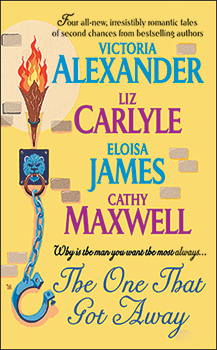
The One That Got Away
A Fool Again is the story of Genevieve, who once made a dash to Gretna Greene to marry, but was caught by her father. Now, a few years later, the story opens at the funeral of her elderly husband (not the man she ran away to marry)…and that’s all I’m going to say, besides to tell those of you who enjoyed Fool for Love that the hero of this story is Darby’s brother, Tobias.
In my own life, I would love to think that I’ve only discarded, rather than lost, the men of my past. But there was one man who got away. He was funny, handsome, startlingly intelligent, imaginative in all right ways: my model for Tobias. We once had a wildly romantic picnic in the rain, under a tarp, eating melon and drinking white wine (watch for a picnic in the rain that turns into something altogether wonderful in my novella!). The great thing about writing fiction is that the Tobiases of our lives come back… I do hope you enjoy A Fool Again.

The One That Got Away
Book Extras

Inside A Fool Again
The carnival scene in this story is partially inspired by personal experience (see my introduction to the story, above), but also by stories of Barthlomew Fair, a wonderful fair from the Renaissance period. As you might know, I'm a professor during the day, and I sometimes teach a play by Ben Jonson called Bartholomew Faire. My fair is a great deal less earthy and less funny than his.

Mea Culpa, A Fool Again
Oops! On page 215, the couch stops and Genevieve almost tumbles into Tobias's lap. Well...I suppose I meant that the coach (or carriage) stops. But in a Freudian kind of way, there could be a double entendre here!

The One That Got Away
Reviews
"A Fool Again is a delightful love story that readers will hate to see end."
— Romance Reviews Today
The One That Got Away
Enjoy an Excerpt
share on:


Jump to Ordering Options ↓
From Chapter One
The Funeral Baked Meats
A well-bred lady never ogles a man from behind her black veil, especially during her husband’s burial. But Lady Genevieve Mulcaster had acknowledged her failings in ladylike deportment around the time she eloped to Gretna Green with a bridegroom whom she’d met three hours earlier, and so she watched Lucius Felton with rapt attention throughout Reverend Pooley’s praise of her deceased husband — a man (said Mr. Pooley) who rose before his servants and even for religious haste, went unbuttoned to morning prayer. Felton looked slightly bored. There was something about his heavy-lidded eyes that made Genevieve feel thirsty, and the way he stood, almost insolently elegant in his black coat, made her feel weak in the knees. His shoulders had to be twice as large as her husband’s had been.
Recalled to her surroundings by that disloyal thought, Genevieve murmured a fervent if brief prayer that Heaven would be just as her husband imagined it. Because if Erasmus didn’t encounter the rigorous system of prizes and punishments he anticipated, he would likely be discomfited, if not sent to sizzle his toes. Genevieve had long ago realized that Erasmus wouldn’t hesitate to rob a bishop if an amenable vicar could be persuaded to bless the undertaking. She threw in an extra prayer for St. Peter, in the event that Erasmus was disappointed.
Then she peeked at Felton again. His hair slid sleekly back from his forehead, giving him an air of sophistication and command that Genevieve had never achieved. How could she, wearing clothes with all the elegance of a dishcloth? The vicar launched into a final prayer for Erasmus’s soul. Genevieve stared down at her prayer book. It was hard to believe that she had lost another husband. Not that she actually got as far as marrying Tobias Darby. They were only engaged, if one could even call it that, for the six or seven hours they spent on the road to Gretna Green before being overtaken by her enraged father. She never saw Tobias again; within a fortnight she was married to Erasmus Mulcaster. So eloping with Tobias was the first and only reckless action of Genevieve’s life. In retrospect, it would be comforting to blame champagne, but the truth was yet more foolish: she’d been smitten by an untamed boy and his beautiful eyes. For that she’d thrown over the precepts of a lifetime and ran laughing from her father’s house into a carriage headed for Gretna Green.
Memories tumbled through her head: the way Tobias looked at her when they climbed into the carriage, the way she found herself flat on the seat within a few seconds of the coachman geeing up the horses, the way his hands ran up her leg while she faintly — oh so faintly — objected. ‘Twas an altogether different proposition when Erasmus stiffly climbed into the marital bed. Poor Erasmus. He didn’t marry until sixty-eight, considering women unnecessarily extravagant, and then he couldn’t seem to manage the connubial act. Whereas Tobias — she wrenched her mind away. Even she, unladylike though she was, couldn’t desecrate Erasmus’s funeral with that sort of memory.
She opened her eyes to the breathy condolences of Lord Bubble. “I am distressed beyond words, my lady, to witness your grief at Lord Mulcaster’s passing,” he said, standing far too close to her. Bubble was a jovial, white-haired gentleman who used to gently deplore Erasmus’s business dealings, even as he profited wildly from them. Genevieve found him as practiced a hypocrite as her late husband, although slightly more concerned for appearances.
“I trust you will return to Mulcaster House for some refreshments, Lord Bubble?” Since no one from the parish other than Erasmus’s two partners, his lawyer, and herself had attended the funeral, they could have a veritable feast of seed cakes.
Bubble nodded, heaving a dolorous sigh. “Few men as praiseworthy as Erasmus have lived in our time. We must condole each other on this lamentable occasion.”
A sardonic gleam in Felton’s eye suggested that he didn’t consider Erasmus’s death the stuff of tragedy. But then, Genevieve had studied Felton surreptitiously for the past six months, and he often looked sardonic.? At the moment he was also looking faintly amused. Surely he hadn’t guessed that she had an affection for him? Genevieve felt herself growing pink. Had she peered at him once too often? Think like a widow, she admonished herself, climbing into the crape-hung carriage.
“May I give you another handkerchief, my lady?” her maid asked as Genevieve seated herself. Eliza had strict notions about the tears a widow should shed during her husband’s funeral.
But Erasmus Mulcaster had long since burned out any affection that his wife might have scrambled together, although not by cruelty, nor by neglect. Erasmus was unfailingly attentive in the two hours he allotted to his wife daily. It was the grueling, grinding boredom of being near Erasmus, of being part of Erasmus’s life, that had withered Genevieve’s affection. Six long years of watching Erasmus count his spoons every night, for he didn’t trust his own butler. Years of turning and re-turning garments because Erasmus considered women’s clothing to be an unnecessary expenditure. He had even dictated, from his deathbed, the refreshments to be served at his funeral: an orange pudding, an almond pudding and two light seed cakes. “Two will be more than enough, if you order them cut very slim,” Erasmus had noted, raising his head from the pillow to make sure that Genevieve understood. He was certainly right about that, Genevieve acknowledged when they reached Mulcaster House and everyone including the vicar refused a piece of cake.
There was general relief when Mr. Leeke, Erasmus’s lawyer, suggested that they retire to the library for a reading of the will. The room was hung in limp, green drapery, and there weren’t very many books, as Erasmus didn’t hold with reading. He didn’t like any activity that hadn’t a clear monetary goal as reward. Genevieve loathed the room, with all its memories of weeping clients and household prayer sessions. Bubble ushered her to a seat for the reading of Erasmus’s will with a solicitous attention that made Genevieve’s skin crawl. What on earth had got into the man? He had to be sixty, if he were a day, and yet he was acting with the skittish enthusiasm of an adolescent hoping for a kiss.
Felton sat in a chair across from Genevieve and Bubble, his pale hair gleaming in the afternoon sunshine. Mr. Leeke cleared his throat two or three times before he began. “Lord Mulcaster’s will is not out of the ordinary,” he announced. “I shall just mention, as I always do before reading a will, that such a document when issued by my firm would be extremely difficult to overturn. Lord Mulcaster was indubitably of sound mind when he established the herein conditions.”
Once, when Felton came to dinner, their eyes met across the table and he smiled at her in such a way that Genevieve felt, well, beautiful. Sometimes she feared that her looks had moldered away like the green draperies lining the casements throughout the house (Erasmus had obtained an excellent price and done every window in the same color). But even though she was all of twenty-four, she wasn’t precisely ancient. Felton had to be in his thirties. Surely he wished to marry? Yet if Felton wanted to marry, why hadn’t he done so? He was extraordinarily handsome, with hair the color of wheat and eyes of indigo blue. And since he was very, very rich (even richer than Erasmus), he’d been the target of match-making mamas for years, from what Genevieve could glean from gossip columns.
“Lady Mulcaster!” Leeke was saying. “This section of the will appertains to you. Well, in fact, to you andthese gentlemen. I know this is a most difficult and distressing time for you, but I must beg the indulgence of your attention.”
Genevieve nodded and clasped her hands in her lap.
“The provision for your future, Lady Mulcaster, is unusual but by no means illegal,” Leeke stated, looking rather uneasily at the papers he held.
Genevieve straightened. What on earth had Erasmus done?
“I consider it an excellent arrangement,” Bubble put in.? “Lord Mulcaster discussed it with me at length, and we agreed that it was a laudable way to ensure Lady Mulcaster’s best interests. A widow so young and beautiful has need of mature advisement,” he said with an arch look at Genevieve.
Felton’s face wore its usual expression of impassive stillness. “Since Lady Mulcaster and I appear to have been excluded from that discussion, why don’t you proceed, Leeke?” he drawled.
“To summarize, then,” Leeke said. “The will specifies that if Lady Mulcaster marries either of Lord Mulcaster’s partners within two years of his death, she will receive his full estate. In the event that Lady Mulcaster either does not marry, or marries another person, Lord Mulcaster’s estate will go the Church of England, with the devout request that a Mulcaster Chapel be dedicated in St. Paul’s Cathedral. Lady Mulcaster will receive only her jointure. Which,” he said, looking at Genevieve, “is regrettably small.”
Genevieve knew that. After all, she was another one of Erasmus’s bargains: he took her for nothing, because she was ruined. Her father had snatched her back from a fate worse than death, a Gretna Green marriage, only to find that she had dallied with her husband-to-be in the coach. And when Tobias Darby didn’t renew his protestations of inebriated love, but took himself off to foreign parts, Erasmus took her second-hand. Would Felton mind that she was a widow? Third-hand, as it were? Presumably he could marry any beautiful young woman in London. She refused to look up, in case she met his eyes.
There was utter silence in the room. The only thing Genevieve could hear was faint barking from the courtyard. Erasmus’s spaniel must have treed a squirrel again. Embarrassment started to burn in her cheeks. Neither man seemed to be eager to propose marriage, even given the sweetener of Erasmus’s bequest. She would have thought that Bubble, at least, would lunge at the estate. “I receive no jointure for two years?” she finally croaked, examining the darn on her left glove.
“No. Mr. Felton and Lord Bubble will establish an allowance for your maintenance and support during the period.”
A surge of rage at her dead husband flushed Genevieve’s cheeks more than did her embarrassment. Erasmus was a tight-fisted old devil. But you already knew that, she reminded herself. It seemed she must find a husband within two years or risk destitution.
“I wish to live in London during my mourning period,” Genevieve stated, looking at Leeke.
The lawyer had a puce-colored face and a habit of avoiding all unpleasant subjects, which had undoubtedly kept his nerves in order while serving Erasmus. “I should have nothing to do with that decision,” he replied promptly. “As I said, your allowance will be entirely the responsibility of these two estimable gentlemen.”
There was silence again. It seemed that she had to take matters into her own hands. Genevieve straightened in such a way as to enhance her chest, and deliberately reached up to pull back her veil. All the black showed her tawny hair to its best advantage. Then she turned to Lord Bubble. She didn’t even need to speak. He exploded into a wilderness of comments about his utter delight at the idea of her hand in marriage, how highly he thought of Erasmus, how exquisitely beautiful she was, how much his (grown) children would love to welcome her as a mother. Genevieve waited, unspeaking, until he wound down like a tired clock, and then she turned, just as deliberately, to Felton.
He had his fingers templed — long, beautiful fingers that made her stomach quake at the very sight of them. “I share Bubble’s enthusiasm,” he said, in a dry tone singularly lacking in enthusiasm. She waited, but all he added was, “Naturally.”
“Of course, no such ceremony could take place until the end of Lady Mulcaster’s mourning period,” Leeke put in. “Lord Mulcaster thought that two years was an adequate period.”
Two years of mourning! Erasmus had high expectations for himself, Genevieve thought sourly.
“So I need not accept one of these two gentlemen’s enthusiastic proposals at this moment?” she asked Leeke, with just the faintest stress on enthusiastic.
“Precisely so, my lady.”
“In that case, gentlemen, I should like an allowance sufficient to establish myself in London during the years of my mourning.”
Leeke cleared his throat. “As it happens, Lord Mulcaster called in a loan just last month and the gentleman in question relinquished a townhouse in St. James’ Square. His lordship hadn’t time to sell the establishment before his untimely death.”
St. James’s Square! Hurrah! Genevieve nodded with widowlike dignity. “That will be acceptable.”
“A modest allowance and use of the townhouse should be more than adequate for the needs of a widow,” Bubble noted, “especially one in the mourning period.”
Genevieve widened her eyes and bit her lip. “The very first thing I desire in a husband is a generous nature akin to that of my dear, loving Erasmus,” she said gently. Bubble undoubtedly knew that any mention of Erasmus’s generosity was a jest: was there another lady within forty miles who was wearing a dress made five years ago and turned twice?
Yet Bubble wasn’t a complete fool. “You are absolutely correct, my dear Lady Mulcaster,” he gushed. “Naturally Felton and I wish you to have a generous allowance, such as Lord Mulcaster would have established for you.”
“The town house will need a full staff,” she noted. Erasmus may have insisted on maintaining only one maid, but she remembered how a house was supposed to be run, and it was supposed to be clean. “And I should like a barouche to be driven in, and a curricle to drive myself. I intend to drive in the park.” Avid reading of the gossip pages had convinced Genevieve that Hyde Park was one of the Seven Wonders of the World.
“As long as I am allowed to chose your horseflesh,” Felton said unexpectedly.
She swept him a glance to find that his eyes were gleaming with something very like a spark of admiration. “That would be most kind of you, Mr. Felton,” Genevieve said. She reached up and pulled her veil over her face again. The subject was closed.
end of excerpt
The One That Got Away
by Eloisa James
is available in the following formats:
→ As an Amazon Associate I earn from qualifying purchases. I also may use affiliate links elsewhere in my site.