


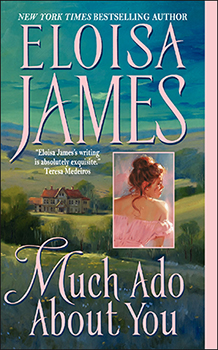
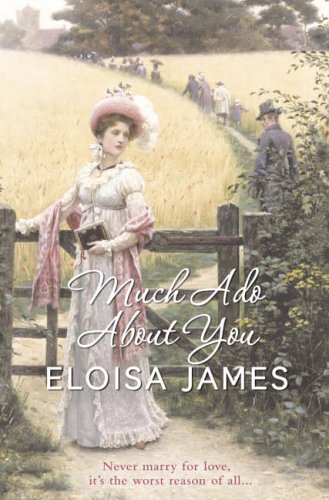
Much Ado About You
Book 1 in the Essex Sisters Series
Teresa Essex has a unique lot in life. Actually…she’d rather prefer that lots were not mentioned. She knows far too much about playing the odds: her widowed father gambled away any spare penny owned by their family. Shillings that should have been spent on gowns and governesses for Tess and her three younger sisters were spent keeping her father’s horses in proper condition for the race track.
When their father dies, the sisters become the wards of the Duke of Holbrook who knows far more about brandy snifters than children. But Tess’s challenges have just begun. With nothing more than a horse each for a dowry, and a drunken duke as a chaperone, she and her sisters must achieve respectable marriages.
In the manner of romantic heroines from the time of Jane Austen, Tess must make a decision whether to marry for financial, prudent reasons, or to follow her heart. But unlike those tales in which heroines prudently make the correct decision, whatever that might be, here fate steps in and Tess must learn a hard lesson: not how to play at love, but how to play at that most serious of pursuits…
Marriage.

Read an Excerpt →
Connected Books →
Book Reviews →
Book Extras →

Much Ado About You
Book Extras

Inside Much Ado About You
Draven Maitland is modeled, to some extent, on Prince from Louisa May Alcott’s Rose in Bloom. If you’ve only read Alcott’s Little Women, this is a wonderful book too–about a little girl who is orphaned and raised by her uncle. Eight cousins swirl around the book, and Prince, beautiful, petulant, rash Prince was my favorite when I was a girl. I cried and cried over Rose in Bloom…
Stepback for Much Ado About You
Enjoy the stepback for Much Ado About You.
Mea Culpa, Much Ado About You
Cherie wrote from England to point out a hideous historical error: on page 286, Lucius describes a portrait of three “children of a roundhead cavalier.” Well, the Roundheads and the Cavaliers were on opposite sides during the English Civil War! And that war took place between 1642 and 1651, so the children would definitely not be wearing “the height of Elizabethan finery,” as they are described on page 359 (Queen Elizabeth died in 1603). I have no defense for this. But may I add a fascinating fact? Much Ado About You was re edited and copy-edited for the English edition by English editors and English copyeditors — and their edition features a roundhead cavalier too!
Essex Sisters Collectible Card
Eloisa made up these gorgeous collectible cards for readers to celebrate the Essex Sisters. With Tess and Annabel on one side and Imogen and Josie on the other, this 5×7 can be yours. And this isn’t the only gorgeous card to be had!
Essex Sisters Series Crossword Puzzle
Enjoy this fun crossword puzzle created for Eloisa's Essex Sisters series!
The Essex Sisters Family Tree
Interested in knowing how many children the Essex sisters had? Eloisa has a beautiful Essex Family Tree for you to see.

Much Ado About You
Reviews
"[Much Ado About You] contains a romance that will induce sighs of satisfaction."
— Publishers Weekly
"Readers' hearts will soar and beg for more."
— Romantic Times BOOKClub (4 1/2 Stars, Top Pick)
"Excellent writing that incorporates humor, usually gentle but sometimes satiric, emotions deeply felt as well as transient, and vital characters who pique immediate interest, make Much Ado About You a must read."
— Romance Reviews Today
"James's gift for superb characterization and elegantly sensual, delightfully witty prose creates a thoroughly romantic treat."
— Booklist (Starred review)
"Ms. James writes regency romance like no other author."
— A Romantic Review
"Very entertaining; historically informed and considerably more literate than many Regencies."
— The Seattle Times
Much Ado About You
Enjoy an Excerpt
Jump to Ordering Options ↓
Listen to an Audio Excerpt ↓
From Chapter Five
Tess found herself to the left of the duke, with Lady Clarice seated to his right. The long table glowed with dishes of a deep maroon with gold bands around the edges. It was set with such an array of silverware that each plate looked as if it had a small shining fence laid on three sides. The silver caught the light of the candles and cast gleaming sparkles on people’s hands.
Suppers during Tess’s life had consisted of two courses at the very most and, in one of their papa’s dry spells, perhaps merely a thin slice of fowl. But on this occasion the courses came and went with bewildering speed. A tall footman with his hair caught back in a snood kept whisking away her plate before she had even tasted it and replacing it with another. And then, just after she would try the new dish, it would vanish. The footman had removed little pastries bulging with chicken and lobster before she finished one, and then a turtle soup briefly appeared, and now they were all contemplating sweetbread pie.
The sparkling drink in their glasses was champagne. Tess had read about champagne but never seen it before. The footman poured her another glass. It was entirely delectable. It fizzled on her tongue and seemed to increase the pleasure of moment immeasurably; Tess even found herself forgetting the fact that she and her sisters looked like so many black crows perched around the table.
“Miss Essex,” her guardian said, when Lady Clarice finally turned to the Earl of Mayne, “it is truly a pleasure and to have you in my house.”
Tess smiled at him. The duke’s slight air of exhaustion made him quite appealing, and the way his hair fell over his eyes was a contrast to the faultless elegance of his friend, the Earl of Mayne.
“We are tremendously lucky to be here, Your Grace,” she said, adding, “rather than in your nursery.”
“Your claim to luck is generous, given that your father’s death that brought you to me.”
“Yes,” Tess said. “But Papa was bedridden for some time before he died, you know. I do believe that he is happier where he is. Papa would not have been content had he been unable to ride.”
“I understood that Lord Essex simply did not wake up, due to a head injury,” the duke said.
“He did wake several times,” Tess explained. “But he was unable to move his limbs. That would not have been a happy circumstance for him.”
“No, I can see that would have been difficult for one of his temperament. I have vivid memories of my first meeting with your father. He had a horse running at Newmarket, years ago, that was. I was a mere stripling. His jockey was lamed in an earlier race so your father leapt onto the horse and rode it himself.”
“I would guess that the horse didn’t win,” Tess said, smiling at the image of it. That was just like Papa – both in the bravado, and in the foolishness.
“No. No, he was far too heavy to win. But he had a wonderful time, nonetheless, and the entire audience was howling for his victory.”
“Alas, Papa rarely won,” Tess said recklessly, feeling as if the champagne had loosened her tongue a bit. “I feel – I feel quite ashamed that he asked you to be our guardian, a man who scarcely knew our family. It’s altogether too much to ask of you, Your Grace!”
But he was grinning at her. Really grinning! “As I told you earlier, it’s a pleasure. I no longer have family of my own.” He looked around. “And I have no plans to marry. So this house and everything in it…no one is enjoying it except for me. I much prefer it like this.”
Tess looked down the table at her sisters, trying to see it through his eyes. Annabel was sparkling, her eyes alight with the pure joy of flirting with the Earl of Mayne. Imogen was glowing with a more subtle happiness; her eyes drifting to Draven Maitland’s face and then jerking away. Tess only hoped that Lady Clarice didn’t notice.
“This is what the dining room was like when my parents were alive,” the duke said. “I’m afraid that I’m become something of a solitary man, without realizing it. I must say, I am enormously pleased to find that my wards are of an age to converse, rather than lisp nursery rhymes.”
“Why did you –“Tess asked and hesitated. Was she right in thinking that proper English ladies didn’t ask personal questions? But she had to know. “Why did you say that you’ll never marry, Your Grace?”
Then she realized that he might guess that they had discussed marrying him, or even think that she had the ambition herself. “Not –“she added hastily – “that I have any personal interest in the question.”
But Holbrook was looking at her with all the oblivion of an older brother. It was clear that he had never even considered the possibility that he might make her, or one of her sisters for that matter, a duchess. Annabel would have to look to one of the other seven dukes if she wished to be a duchess. Or perhaps – Tess looked down the table again and caught Annabel laughing at the earl – perhaps she could simply turn to their guardian’s friend.
“There are a few of us who eschew the whole process,” Holbrook said. “And I’m afraid that I’m one of them. But it’s not due to misanthropy, Miss Essex.”
“Do, please call me Tess,” she said, drinking a bit more champagne. “After all, we are family now.”
“I would be more than pleased,” he said. “But you must call me Rafe. I loathe being addressed as Your Grace. And may I say, that I am tremendously happy to have acquired a family?”
She smiled at him, and there was a moment of perfect ease between them, as if they’d been siblings for life.
“I’ve never had a sister,” he said, nodding to the footman who wished to refill her champagne glasses. He was drinking a large glass of something golden, and quite without bubbles. “I believe it’s quite a different relationship from that one has with a brother.”
Their Debrett’s may have been two years out of date, but it did list the duke’s brother, with a little note, “deceased,” beside it. Tess’s champagne sent tingling little chills down her throat; the very idea of losing one of her sisters was inconceivable. “I know that you once had a brother,” she said rather haltingly. “I am sorry, Your Grace.”
“Rafe,” he corrected her. “To be honest, I think of myself as still having a brother. He simply isn’t with me any longer.”
“I know just what you mean,” Tess said impulsively. “I keep expecting Papa to walk in the door. Or even my mother, and she’s been gone for years.”
“A maudlin pair of us, then,” he said, his eyes twinkling.
But Tess could see the sadness at the back of those brown eyes, and felt a sudden surge of liking for their unkempt, rather lonely guardian.
“Now tell me what it’s like having sisters – and so many of them,” he said, drinking from his glass again.
“Sisters are very good at keeping secrets,” Tess answered. “My sisters and I keep reams of them amongst ourselves.”
“Of what sort, pray?”
“These days, they are mostly to do with matters of the heart,” Tess said, wondering if perhaps she had had rather more champagne than was entirely wise.
“Ah,” he said. And then: “Should I be expecting a group of Scottish suitors to arrive at my doorstep, then?”
“Not for me, alas,” Tess said, devoting herself to a piece of plaice in a delicate cream sauce. “In fact, not for any of us. Papa had great plans, you see. Once he won a truly large purse, he was going to bring us to London for the season. He wouldn’t listen to the suits of local gentlemen.”
“If you’ll forgive the impertinent question, did any of you ever develop an affection for any of these suitors? For surely they existed, your father’s permission or not.”
“Here and there,” Tess said airily, “one developed a tendrance. But it was a bit difficult, you understand, due to Papa’s strictures as concerned the local nobility.”
His face was alive with interest, which was a heady pleasure for Tess. When was the last time that someone besides her sisters showed an interest in her opinions?
“Did you ever fall gain acquaintance with one of these inappropriate men? Is that one of your many secrets?”
“If I tell you,” she said with a small hiccup, “you must needs tell me a secret as well.”
“The only problem will be thinking of one,” he said, “for I lead a tediously proper life. So is some Scottish lad fair slain for love of you?”
“I did fall in love once, with the butcher’s boy,” she told him. “He was called Nebby, and he was truly an enchanting young man although not precisely eligible.”
“I should think not. What did Lord Essex do on learning of this remarkable attachment?”
“My father encouraged it,” Tess said, giving him a small grin.
Rafe blinked. “Really?”
“He thought it was a most useful connection, because Nebby brought me pieces of meat as a sign of his affection. We were,” she added, “both eleven years old, and so my father had little fear for of permanent affection between us. The truth is that Nebby cast me off, married at a young age and is already the father of two spanking young future butchers.”
“Young Nebby was the last to have captured your affections?”
“The very last,” Tess nodded.
Rafe seemed to manage to shovel down his supper, whereas she kept forgetting and allowing the footman to take away untouched plates of food. He touched his glass of golden liquor to her champagne. “I believe that you and I are of a type. Untouched by matters of the heart.”
“Alas,” Tess said. “Love doesn’t seem to be my forte. I find courtship rather tedious, if the truth be known.” Then it occurred to her that he would likely take that news with dismay, given the idea that his guardianship extended until she married. “Not that I am adverse to the idea of matrimony,” she hastened to tell him. “You needn’t worry that I shall plague your household forever; I fully intend to marry.”
“You relieve my soul,” Rafe said, laughing.
“Now,” she said, leaning towards him, “you’ll have to tell me a secret. I would like to know what’s turned you into such a misanthrope about marriage.”
“Why on earth would you be interested in such a triviality?” Rafe asked. Unless he was much mistaken, his new ward was just a tiny bit muzzly on champagne. Likely a guardian wasn’t supposed to allow his wards to become chirping-merry. Perhaps he should substitute lemonade for champagne? But he loathed a hypocrite, and he had no intention of giving up his brandy. He drank half the bumper on the thought.
Tess was talking, and he pulled his attention back to her with a jerk. “Because if you don’t, I’ll allow Annabel to continue in the mistaken belief that she could become Duchess of Holbrook with a mere crook of her little finger.”
His eyes widened and he looked down the table. At that moment, Annabel looked up and smiled. There was nothing overt about her smile. She was, quite simply, one of the most beautiful women Rafe had ever seen, with her buttery hair that gleamed with the dull gold of old silk in the candlelight, her eyes tilted slightly at the corners, marked with sooty eyelashes. Even in drab mourning clothing she was formidable. But he hadn’t the faintest inclination to marry her, magnificent or not.
“She would make a lovely duchess,” her sister told him.
Rafe narrowed his eyes at Tess. “I see you have some of your father’s bravado.” There was Annabel, glowing like a piece of expensive jewelry, down the table. And then here was Tess. Her clear blue eyes had the same tilt as her sister’s, but they spoke of intelligence, courage and humor, rather than pleasure. “You have no plans to become a duchess, do you?” he asked, wondering as he said it whether the brandy had gone to his head the way the champagne had to hers.
She shook her head.
“You would really terrify me,” he said frankly. “In fact, should you have made up your mind in that direction, I might have had to flee to the North Country.”
“A remarkable compliment,” Tess said. “I think I would be more moved by it had you not mentioned the prospect of flight.”
Just then Brinkley entered the dining room and stooped at Rafe’s side. “Mr. Felton has arrived from London,” he said. “He has assented to joining you for a trifling repast. I suggest that we place him beside Miss Essex.”
“A friend,” Rafe explained, turning to Tess. And then, to Lady Clarice, “Yes indeed, Mr. Felton. We were at school together, although that was many years now.”
“Not so long,” Lady Clarice said archly. “You’re not more than your mid-thirties, Your Grace, and I won’t have you pretending to be an elder statesman!”
Tess blinked. Perhaps the earl was right and Lady Clarice pictured herself a future duchess. Well, if Annabel rushed to imagine herself in the position, why should not every widowed or single lady in the vicinity?
She caught the duke’s eye. He gave her a crooked smile as he leaned closer to Lady Clarice, who had declared the need to tell the duke something tremendously humorous that happened at the last Silchester assembly.
A footman began placing a setting to the left of Tess. She finished her plaice, listening to Lady Clarice prattle to Rafe of an agreeable interlude in which a dear, dear friend of hers had quite lost the anchoring on her bodice whilst in the midst of a crowded room, or so Tess understood. From Lady Clarice’s relish in repeating the episode, one grasped immediately the idea that the friend in question had neglected to put on sufficient undergarments.
Then the door opened again, and Brinkley ushered in Rafe’s new guest. It must be the champagne, Tess thought rather foggily, a second later.
The man who entered the room after Brinkley looked like a fallen angel. The candelabra on the table bounced light from Mr. Felton’s sleek hair, off his austere face, off the severe line of his nose. He was wearing a black coat with a velvet lapel. He looked every inch a duke, every inch a patrician, a wealthy creature of privilege. And yet there was a sense in which he was like one of her father’s stallions: large, beautiful, a man who dominated the room merely by entering it. A man whose eyes showed a combination of restraint and a faint boredom, a sleek man.
A rather terrifying fallen angel, really.
end of excerpt
Much Ado About You
by Eloisa James
is available in the following formats:
→ As an Amazon Associate I earn from qualifying purchases. I also may use affiliate links elsewhere in my site.